Words: Helen Fenton, Alan Rosser & Will Walton
Our story begins in 1989, as a small charity in Salford with a mission to tackle disadvantage and change lives. Officially incorporated in 1990, we’ve grown significantly over the past 35 years, adapting to the evolving needs of the community and expanding our reach across Greater Manchester.
The early years (1988-1993)
In 1988 the Conservative government initiated a pilot scheme called “Action for Cities,” focused on a number of inner city areas in England known as “Compacts”. These organisations were established to encourage business and commercial organisations in cities to provide employment opportunities to young people from inner city schools leaving at age 16.
Salford Compact was founded in 1989 with an initial workforce of just three people, two of whom – Peter Collins (CEO) and Alan Rosser (Deputy CEO) – remained with the organisation for over twenty years. The charity initially operated out of an industrial estate in Patricroft, quickly establishing itself with Salford High Schools and in 1990, Salford Compact secured funding from the Department for Education to pilot a mentoring project. This was designed to recruit adult mentors from the business and wider community to help 15 and 16 year olds in local schools with their life, social and learning skills. This project was immediately hugely successful and quickly spread across the city.
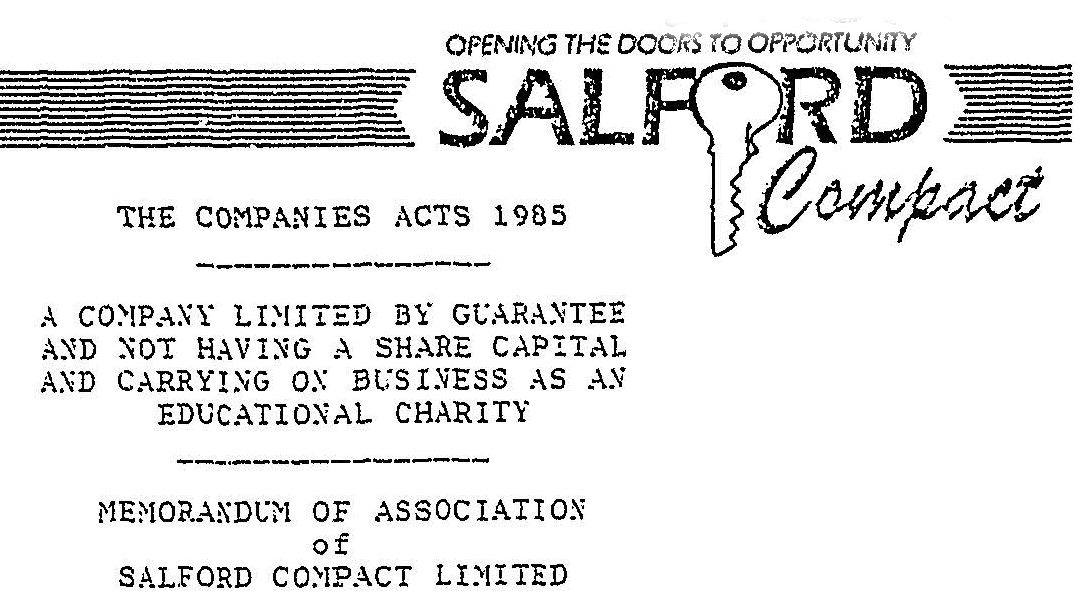
Salford Compact’s founding document, provided to the Companies House in December 1989
Trailblazing in Salford (1994-1998)
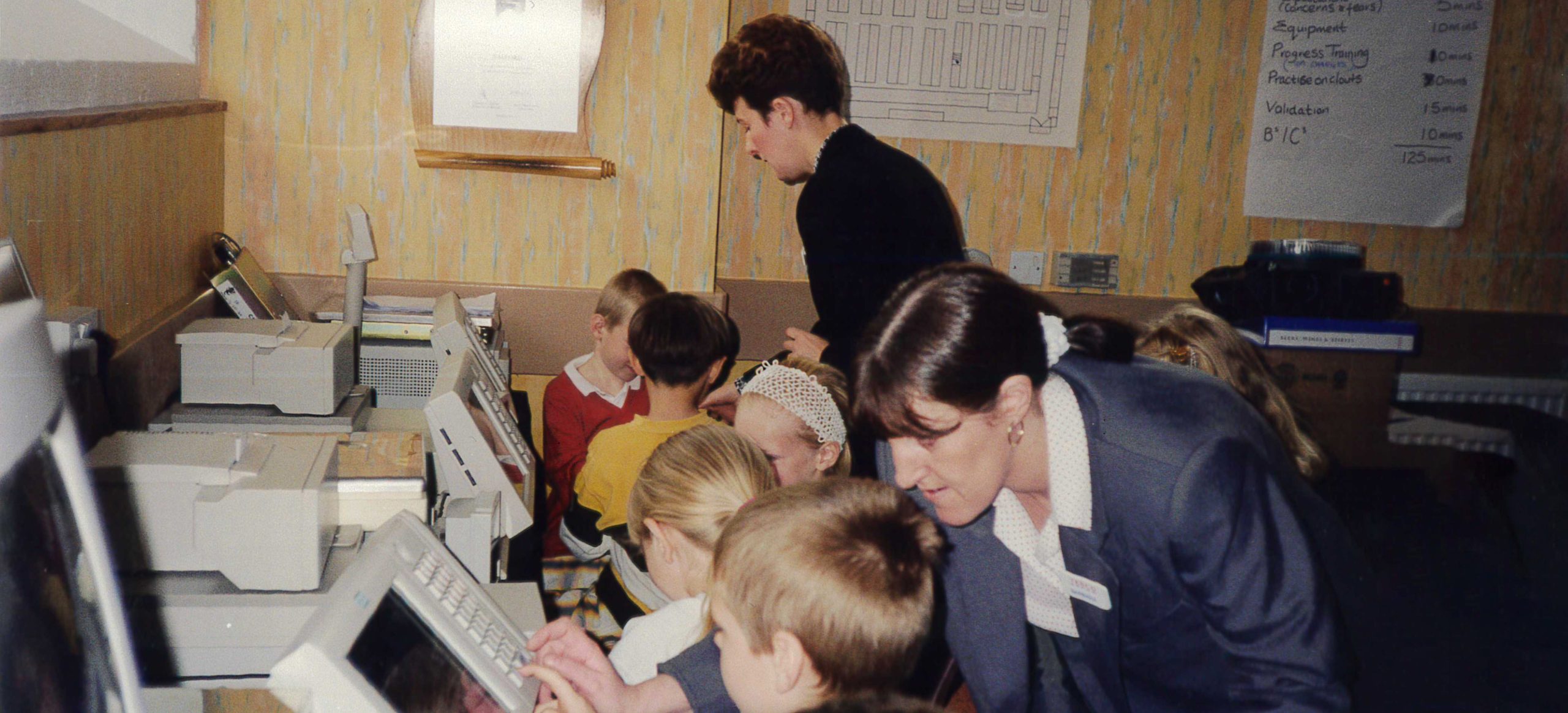
By 1994, Salford Compact had rebranded as Salford Foundation and was instrumental in introducing Mentoring programmes to schools in Greater Manchester. This then extended to the founding of the National Mentoring Network (NMN), leading the way with the production of guidance, training and networking opportunities including the annual National Mentoring Conference for mentoring programmes across the UK. The NMN then evolved to become The Mentoring and Befriending Foundation, enabling mentoring programmes to become accredited and leading on best practice across Great Britain.
With the Labour Party’s victory in 1997, Salford Foundation became one of the first Education Action Zones (EAZ) in the UK in 1998. EAZ’s prioritised areas of high poverty, unemployment and social exclusion. Salford Foundation’s leadership of the Salford EAZ, ensured successful cross working between school leaders, parents, local authority, business representatives and community members. Education Action Zones and City Learning Centres were particularly important locally. The EAZ initiative enabled the charity to expand its work into Wythenshawe in Manchester.
Into the millennium (1999-2009)
From this time onwards, Salford Foundation evolved extensively, working with an increasingly wide variety of people in many different, often difficult, circumstances. By the year 2000, the charity had expanded its workforce to 15 people and was instrumental in developing the Millennium Volunteers (MV) initiative across Greater Manchester. Launched in 1999 by the Department for Education, the initiative promoted sustained volunteering among young people aged 11 – 25, by providing certificates for 50, 100, and 200 hours of service.
Starting in 2001 as a project with a team of two, Salford Foundation established the Together Women’s Project (TWP) as an exemplar for supporting women facing barriers in day-to-day life. This expanded into a wider support service and by 2007, a dedicated Women’s & Survivors’ centre was established. This quickly became a lifeline for vulnerable and marginalised women in Salford, supporting women with complex issues such as domestic abuse, poverty, debt, substance misuse, mental health struggles, housing, and employment.
Building better futures (2010-2023)
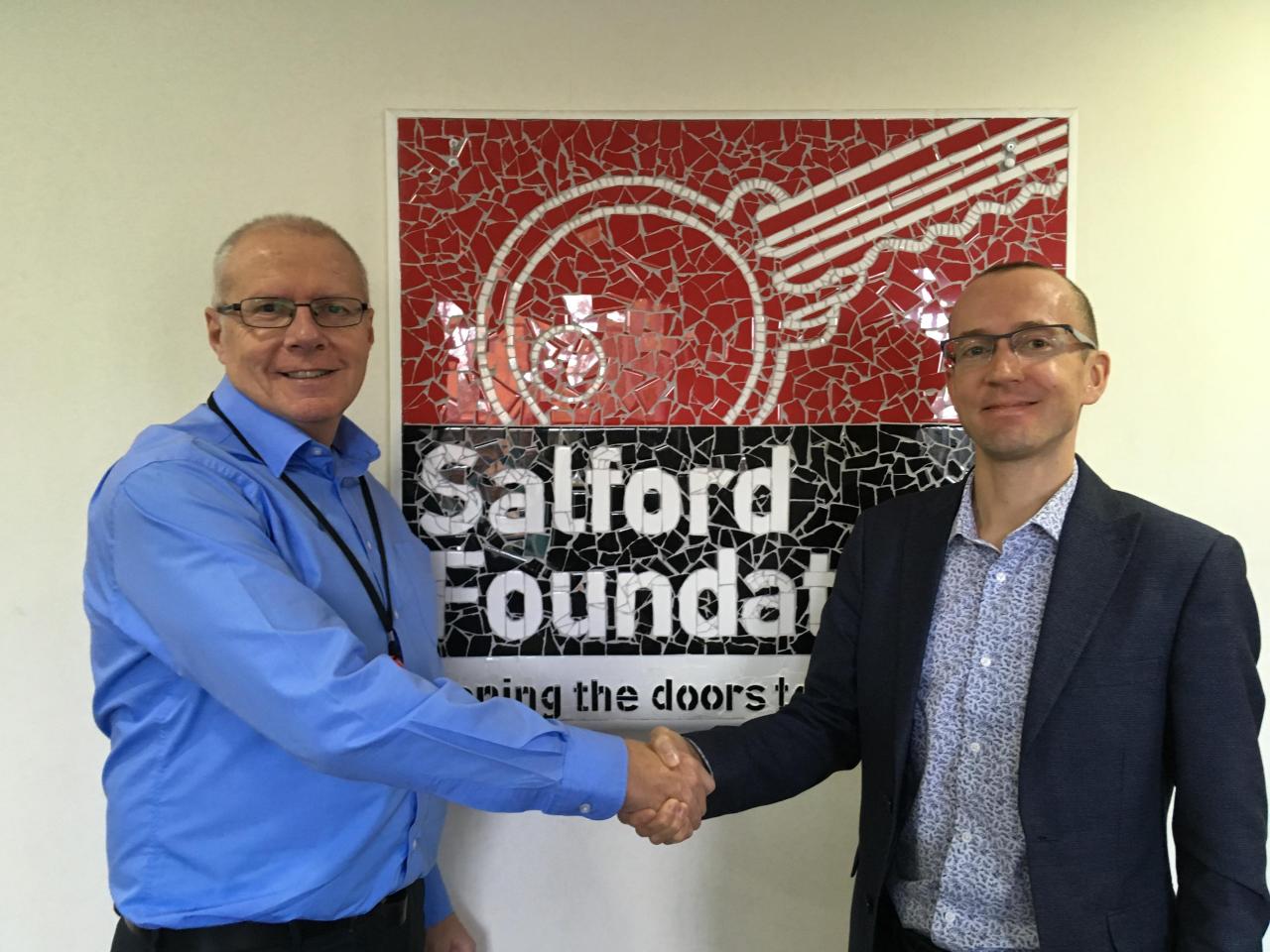
In 2010, Salford Foundation made a strategic move and purchased the newly branded ‘Foundation House’ on Jo Street. Phil East joined Salford Foundation in 2011 on a project called OneThreeOneNine, initially as Deputy Chief Executive, eventually succeeding Peter Collin’s as Chief Executive of Salford Foundation in 2018, ahead of his planned retirement in 2019.
Between 2012 and 2023, Salford Foundation delivered multiple National Citizen Service (NCS) programmes for young people, engaging more than 13,157 disadvantaged young people aged 15 to 25 in Bolton, Salford, Trafford and Wigan. Activities included residential trips, skills development, and community social action projects like winter hampers for the homeless.
2015 saw the Foundation’s Women’s & Survivors’ Services expand into the criminal justice system. With funding from Achieve North West, the Achieve Prison Mentoring project supported the rehabilitation of 1,912 people across 7 prisons between 2015 and 2023. Prisoners were offered 6 one to one sessions in custody coaching, mentoring, wellbeing and employability support. Mentors aimed to improve prisoners’ motivation, agree goals and resettled people back into the community.
Following the success of the gender specific Women’s and Survivors’ Service, Salford Foundation’s Men’s Centre (The Shed) was established in 2019, with a focus on employment, education, mental health, and support for men involved in the criminal justice system. The project quickly grew, moving to its own dedicated space at Acton Square, Salford in 2021. It now supports around 2,000 men per year offering intensive support for underrepresented and hard to reach men aged (18+) facing substantial barriers to their full participation in society.
In 2022, Salford Foundation entered a partnership with TDAS, TLC, and The Pankhurst Trust to form the flagship domestic abuse support program, the Safe in Salford partnership, which has since become a cornerstone of the domestic abuse support network in Salford and Greater Manchester.
Tackling disadvantage; changing lives (2024-present)
From May 2024 to April 2025, Salford Foundation ran the first iteration of Steps, a Gender-Based Violence (GBV) education programme focused on reducing misogynistic attitudes and behaviours in primary and secondary school settings. It addressed the behaviours that enable and excuse GBV and empowered boys to make their own communities safer and more equitable, ultimately working with 745 boys in Years 5-8 across eight schools in Greater Manchester, and positively impacting their behaviour and contributing to an improved understanding of Gender-Based Violence. The project received national attention, including coverage on ITV news in April 2025.
After eight years in post, Phil East announced in January 2026 that he was stepping down as Chief Executive and moving on to work as CEO for Caritas Care. He was succeeded by Mel Goddard in April 2026, the first woman to hold the post of Chief Executive at Salford Foundation and previously CEO of The Roberts Centre in Portsmouth. Her background includes extensive operational and strategic leadership, with a strong focus on services supporting homeless families, children and young people.